Drag the sliders – the time updates instantly.
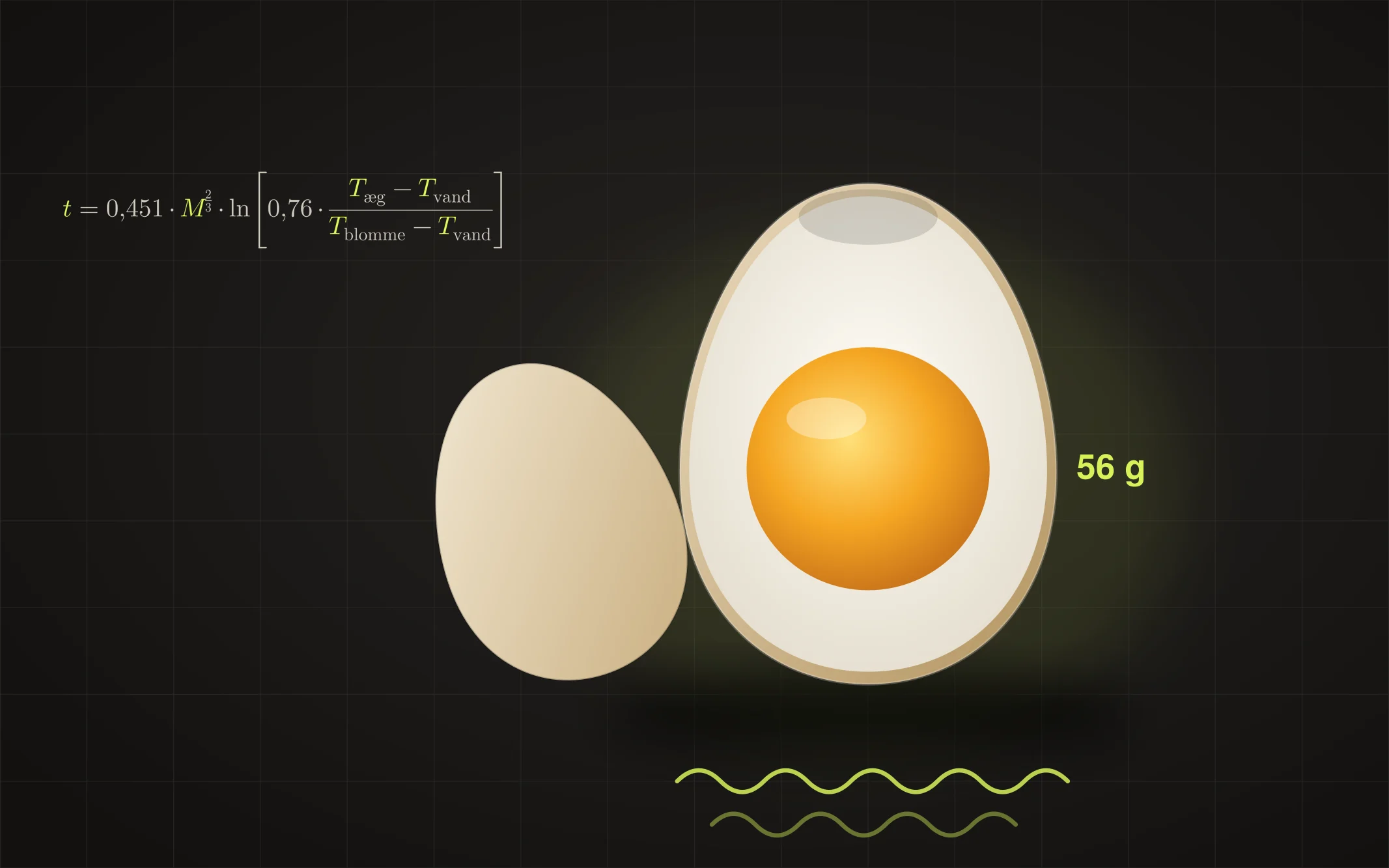
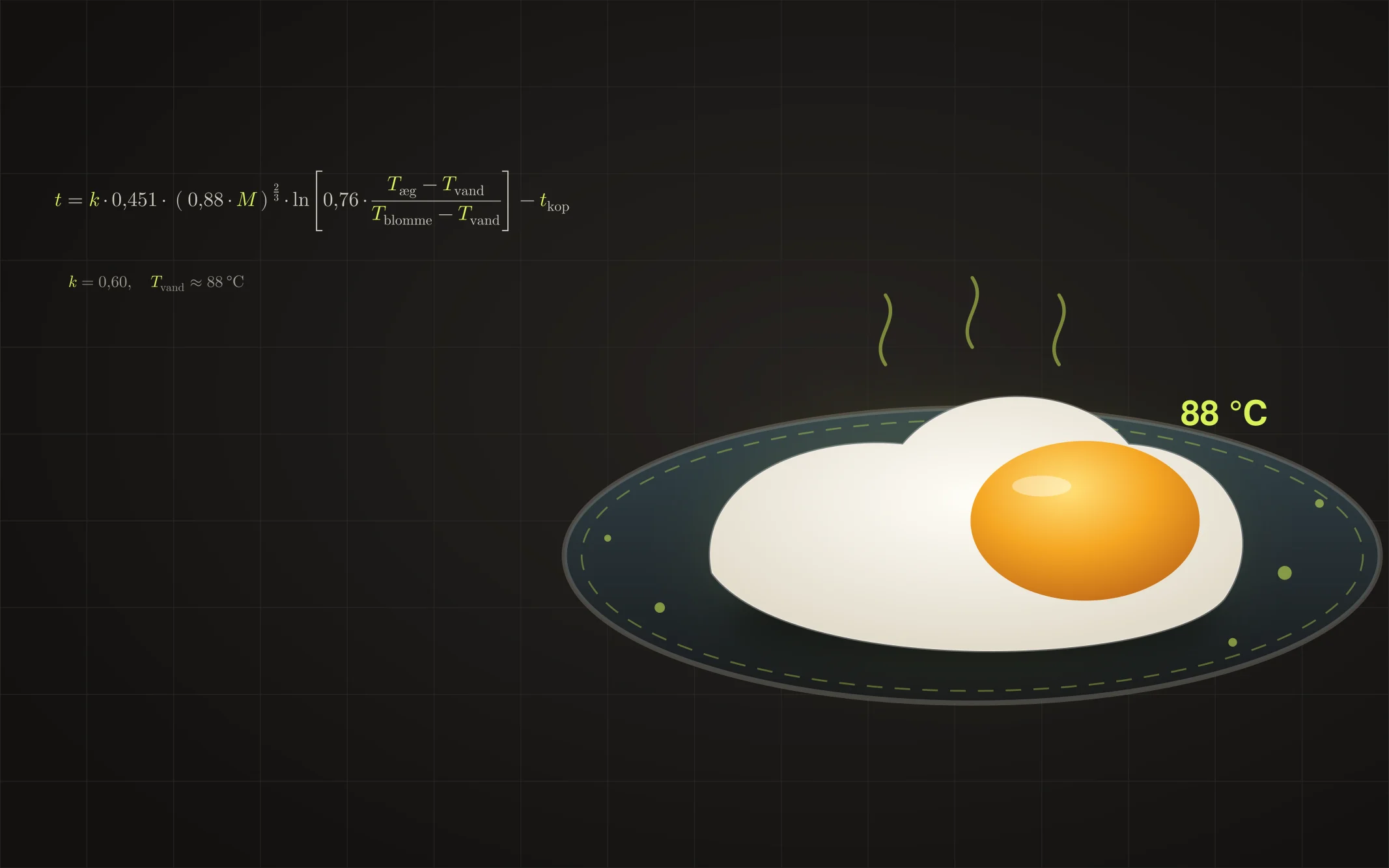
The model is Williams' spherical formula for a shell-less egg with a shape factor for the flattened form (tuned to practice). ±20 seconds is normal – lift the egg with a slotted spoon and feel it: the yolk should give like a water balloon.
A poached egg is a boiled egg without its shell: the same physics, but the heat goes straight into the white, the yolk sits closer to the surface, and the water must not boil. The calculator above works out the time for your egg, the yolk you want and the water temperature you poach at – and it allows for the little trick that makes all the difference: scalding the egg with boiling water before it goes into the pan. If you'd rather keep the egg in its shell, use the formula for boiled eggs.
The outermost white meets the water directly and sets within seconds, while the yolk in the middle warms up more slowly. The white starts to firm at 62 °C and is set at 65 °C; the yolk thickens from 65 °C, is jammy at 67–68 °C and fully firm at around 76–80 °C. Poached at 85–90 °C rather than in boiling water, the white turns soft and silky instead of rubbery, and the bubbles don't tear the egg apart.
A poached egg is lower than it is wide, and the yolk sits just under the surface. That is why it cooks faster than a boiled egg in its shell even though the water is cooler: less mass to heat, no shell, and a shorter path to the yolk.
The starting point is the same model as for boiled eggs – Charles D. H. Williams' formula for a sphere heated from the surface – with three adjustments:
The weight is on the carton – the EU classes are weight classes – or read off kitchen scales. If you weigh the egg in its shell, the calculator deducts the 12 % itself; if you weigh the cracked egg in the cup, switch the toggle off and get the exact mass directly.
| Size (EU) | Weight with shell | Typical | Without shell |
|---|---|---|---|
| S | under 53 g | 48 g | ≈ 42 g |
| M | 53–63 g | 56 g | ≈ 49 g |
| L | 63–73 g | 68 g | ≈ 60 g |
| XL | over 73 g | 78 g | ≈ 69 g |
Altitude plays no part here as long as you stay below the boiling point: 88 °C can be reached up to about 3,500 metres.
Vinegar lowers the pH, so the proteins in the white set faster and at a lower temperature – which is why the cup trick works so well. A tablespoon in the cup is plenty; in the pan itself it isn't needed, and too much gives a sour taste and a dull surface.
The vortex – stirring the water and dropping the egg into the middle – gathers the white around the yolk in the pan. It's redundant once the egg has been scalded in the cup, and it only works for one egg at a time.
Freshness matters more than anything else. The thick white closest to the yolk gets thinner and more watery with age, so a two-week-old egg spreads out like a fan in the pan. An egg under a week old holds its shape almost by itself. If your eggs are older, crack them into a fine sieve and let the thin white drain off before scalding.
Several eggs at once: give each egg its own space and add them a couple of seconds apart, so you can take them out in the same order. Four eggs drop the water temperature by a couple of degrees – turn up a little, or add 10–15 seconds.
The physical core is Williams' model, but the shape factor is empirical, and a poached egg is less uniform than a boiled one: the white may lie thicker on one side, and the egg may sit askew on the bottom. Allow ±20 seconds and feel it with the slotted spoon: the yolk should give like a small water balloon. Too loose? Add 20 seconds next time.
hoerup.dk/en/old-recipes/interactive-formula-for-poached-eggs/