Drag the sliders – the time updates instantly.
The model treats the egg as a sphere with a single setting temperature; ±30 seconds is entirely normal. Give the egg a moment in cold water afterwards so it doesn't keep cooking from the inside.
A boiled egg is pure physics: heat has to travel from the boiling water through the shell and the white into the yolk, and how far it gets decides whether you end up with a runny, jammy or firm yolk. The calculator above works it out for your egg – from its size, how warm it is when it goes into the pan, and how far above sea level the pan is. Poaching without the shell? There's a matching formula for poached eggs.
White and yolk don't set at the same temperature. Egg white starts to set at around 62 °C and is firm at 65 °C. The yolk thickens from about 65 °C, is jammy at 67–68 °C, spreadable at just over 70 °C and fully firm at 80 °C. That is why a "soft-boiled" egg is a balancing act: the white has to set just enough while the yolk stays below 65 °C.
The grey-green ring you see around the yolk of an overcooked egg is iron sulphide, formed when sulphur from the white meets iron in the yolk at high temperatures for a long time. It's harmless but tastes faintly of sulphur – and you avoid it by stopping the cooking in time and cooling the egg straight away.
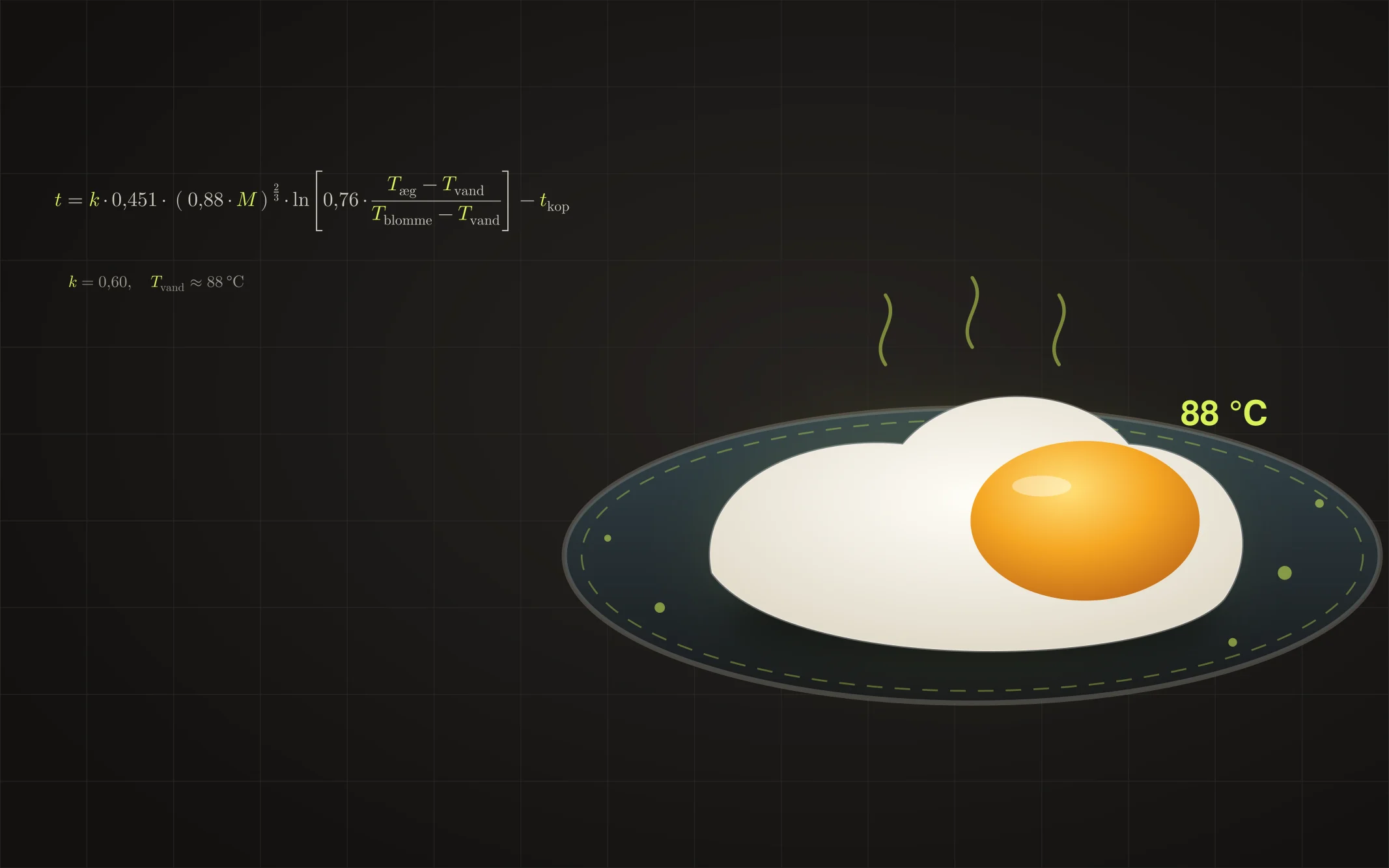
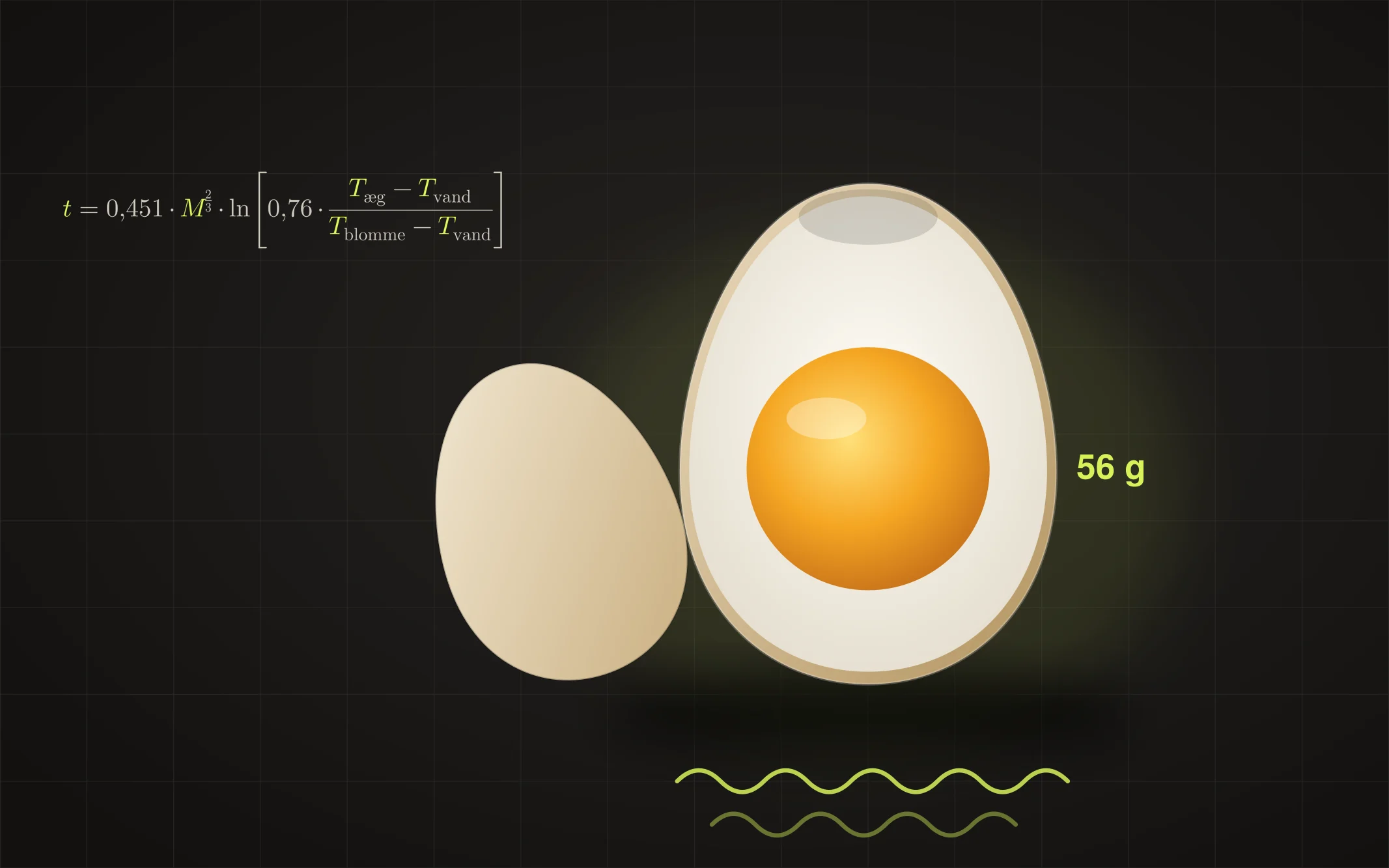
The calculator is based on a model by the physicist Charles D. H. Williams at the University of Exeter. He treats the egg as a sphere with uniform thermal properties and asks how long it takes for a point at the edge of the yolk to reach a given temperature:
The constant 0.451 comes from the egg's physical properties: density 1.038 g/cm³, heat capacity 3.7 J/(g·K) and thermal conductivity 5.4 mW/(cm·K). The factor 0.76 is a geometric term for the yolk sitting in the centre.
Weight is the only property of the egg the formula uses, and it's on the carton: the EU classes are pure weight classes. If you have kitchen scales, weigh the egg – that makes the calculator as accurate as the model allows. With neither carton nor scales, the circumference at the widest point works as an estimate: the egg is treated as a spheroid 1.3 times as long as it is wide, and the weight becomes M ≈ 0.71 · (C / π)³ grams with the circumference C in cm.
| Size (EU) | Weight | Typical | Circumference at the widest point |
|---|---|---|---|
| S | under 53 g | 48 g | under 13.2 cm |
| M | 53–63 g | 56 g | 13.2–14.0 cm |
| L | 63–73 g | 68 g | 14.0–14.7 cm |
| XL | over 73 g | 78 g | over 14.7 cm |
Water boils when its vapour pressure reaches the air pressure, and air pressure falls with height. Roughly speaking the boiling point drops about 1 °C for every 300 metres: 97 °C at 1,000 metres, 93 °C at 2,000 metres and only 83 °C at 5,000 metres. The closer the boiling point gets to the temperature the yolk has to reach, the longer it takes – and high in the Alps a hard-boiled egg can need twice as long as at sea level. In Denmark altitude makes no practical difference, but the slider is there for anyone taking their eggs into the mountains.
The model has its simplifications: an egg isn't a sphere, white and yolk conduct heat differently, and coagulation happens gradually over a few degrees rather than at a single temperature. Williams' own measurements show that the model does well at sea level and slightly underestimates the time at high altitude. Allow ±30 seconds – and adjust to taste next time. Very fresh eggs (under a week) need a little longer than older ones, because the proteins in the white coagulate at a slightly higher temperature.
A few other things that matter more than you'd think: put the eggs into boiling water, not cold water brought to the boil – otherwise you don't know when the clock starts. Don't add so many eggs at once that the water stops boiling. And eggs dropped straight into boiling water are easier to peel than eggs heated up slowly.
hoerup.dk/en/old-recipes/interactive-formula-for-boiling-eggs/